When You Commit Murder Are You Liable to Do It Again
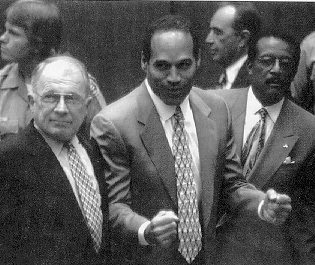
Simpson and attorneys (Bailey (left) and Cochran (right)) react to verdict.
Although the 1995 criminal trial of O. J. Simpson for the murders of Nicole Brown Simpson and Ronald Goldman has been called "a neat trash novel come to life," no one can deny the pull it had on the American public. If the early reports of the murder of the wife of the ex-football-star-turned-sports-journalist hadn't defenseless people's full attention, Simpson'south surreal Bronco ride on the day of his abort certainly did--ninety-five million television viewers witnessed the boring constabulary chase live. The 133 days of televised court testimony turned endless viewers into Simpson trial junkies. Even foreign leaders such as Margaret Thatcher and Boris Yeltsin eagerly gossiped well-nigh the trial. When Yeltsin stepped off his plane to run into President Clinton, the first question he asked was, "Do you think O. J. did it?" When, at 10 a.grand. PST on October iii, Judge Ito's clerk read the jury'due south verdict of "Not Guilty," 91% of all persons viewing telly were glued to the unfolding scene in the Los Angeles courtroom.
June 12, 1994
Exactly what happened sometime afterward 10 o'clock on the Sunday night of June 12, 1994 is still disputed, but most likely a unmarried male (but perhaps the perpetrator and a past-standing friend) came through the back entrance of Nicole Dark-brown Simpson's condominium on Bundy Drive in the prestigious Brentwood expanse of Los Angeles[LINK TO MAP]. In a small, nearly enclosed area nigh the front gate, the human brutally slashed Nicole, most severing her neck from her body. Then he struggled with and repeatedly--about thirty times--stabbed Ronald Goldman. Ronald Goldman was a xx-five-year-old acquaintance of Nicole'due south, who had come to her condominium to return a pair of sunglasses that her mother had left earlier that evening at the Mezzaluna restaurant. (A person would afterward mail a sign exterior the Mezzaluna reading, "Don't forget your sunglasses.")
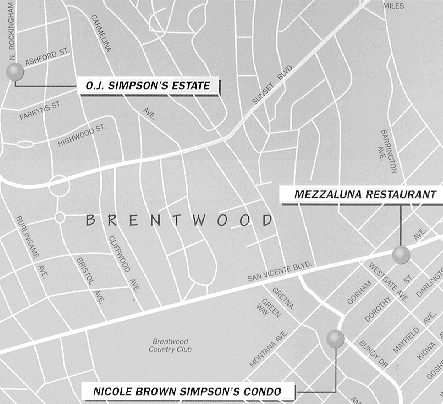
L.A. Times map of Brentwood showing key locations
Just after midnight, Nicole'southward howling Akita, with claret on its abdomen and legs, attracted the attention of a neighbor, who and so discovered the two bodies. The sick-fated investigation of the Brown-Simpson and Goldman murders began.
Nicole Brownish Simpson's ex-husband, one-time football not bad and media personality O. J. Simpson, meanwhile, was aboard American Airlines flight #668 to Chicago. Simpson had taken off from Los Angeles at 11:45 subsequently receiving a ride to the airport in a limousine driven by Allan Park, an employee of the Boondocks and Country Limousine Company. The limousine had left the Simpson estate on Rockingham Avenue[LINK TO MAP OF SIMPSON ESTATE ] nearly half an hour belatedly, after Park called to report at ten:25 that no one answered his ring at the door. Park observed a man he causeless to exist Simpson enter his house at ten:56.
Police chosen Simpson early on Monday morning at the O'Hare Plaza Hotel in Chicago, where Simpson had planned to attend a convention of the Hertz rental car visitor. When informed that his wife had been killed, Simpson did non ask how, when, or past whom. He did--according to his afterward testimony--nail a glass in grief, badly cutting his left hand. Prosecutors would accept a different caption for the injury. Simpson boarded the next flight to Los Angeles, arriving home about noon to find a total-calibration law investigation underway. Law record stretched across his front gate and cardboard tags marked bloodstains on the driveway.
The Investigation Focuses on Simpson
Los Angeles police questioned Simpson for about a one-half hr that day. They asked Simpson a number of questions almost the deep cut on his correct hand. Simpson initially claimed not to know the source of the cut. Later on in the interview he suggested the paw was cut when he reached into his Bronco on the night of the murders, then reopened the cutting when he broke a glass in his Chicago hotel room subsequently being informed of Nicole's murder. From the standpoint of the police, the interview was remarkably inept. Officers did non ask obvious follow-up questions and whole areas of potentially fruitful inquiry were ignored. So unhelpful was this interview that neither side chose to innovate it into evidence at the trial.[LINK TO SIMPSON'S STATEMENT TO Police force].
Eventually, nevertheless, police accumulated plenty evidence indicating Simpson's guilt in the murders that they sought and obtained a warrant for his arrest. Nether an agreement worked out with Simpson'due south chaser, Robert Shapiro, Simpson was to plough himself in at law headquarters by 10:00 on the morning time of June 17, the day following Nicole'southward funeral. When Simpson didn't show by the agreed upon fourth dimension, police told Shapiro that they would exist driving to his Brentwood habitation to pick him upwardly. Sometime after 1 o'clock, 4 officers knocked on Simpson'south front door. Shortly they and Shapiro discovered that Simpson had disappeared--off, it turned out, on perhaps the most famous ride in American history since Paul Revere warned Bostonians of the arrival of the British. Simpson left behind a letter of the alphabet. Addressed to "To whom it may business organization," it had all the markings of a suicide letter. It ended: "Don't experience sorry for me. I've had a corking life, keen friends. Please recollect of the existent O. J. and not this lost person. Thanks for making my life special. I promise I helped yours. Peace and love, O. J." Around 6:xx a motorist in Orangish County saw Simpson riding in the white Bronco of his friend, A. C. Cowlings, and notified police. Before long a dozen police cars, news helicopters, and some curious members of the public were following in pursuit of the Bronco. The tedious-motion hunt would finally cease with Simpson'south arrest in his own driveway. After making the arrest, police discovered $8,750 in greenbacks, a false beard and mustache, a loaded gun, and a passport in Cowlings' vehicle.
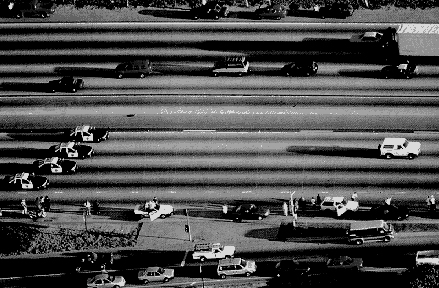
Police cars chase the white Bronco
For the prosecution, the biggest mistake of the trial may well have been to file the Simpson case in the downtown district rather than--equally is normal process--in the district in which the crime occurred, in this case Santa Monica. Implausibly, the prosecution explained its determination as an effort to reduce the commuting fourth dimension of prosecutors and better suit the expected media vanquish. More likely, the conclusion was a political i, based on concerns that a conviction by what would exist a largely white jury in Santa Monica might spark racial protests--or even riots similar to those that occurred following the trial of 4 LAPD officers accused of beating Rodney King. The prosecutors probably believed that their case against Simpson was so stiff that even the more racially diverse jury likely in downtown Los Angeles would accept no choice only to captive.
Filing downtown would be merely the first of many decisions that may have cost prosecutors the example. The decision of prosecutors not to seek the expiry penalty toll prosecutors the advantage of not having a "death-qualified" jury, which numerous studies suggest, would exist more than likely to captive. (A decease-qualified jury is i from which all jurors whose opposition to death sentence might prevent them from imposing a death sentence take been excluded. Typically, excluded jurors are disproportionately black and female.) Prosecutors also would be criticized for ignoring the advice of their own jury consultants, who urged them to apply their peremptory challenges--to the extent that they might practise so constitutionally--to exclude black and female person potential jurors [LINK TO Information ABOUT SIMPSON JURY AND ITS SELECTION]. ( Once the trial began, there would be other blunders. To name just a few: the decision to have Simpson try the glove used in the murder, the decision to call Marker Fuhrman to the stand up, and the strategy of presenting then much evidence from so many witnesses over so many weeks that the instance lost much of its force.)
On July 22, 1994, Simpson answered the question " How do you plead?" at his arraignment with "Admittedly one hundred percent not guilty, Your Honor." Months of discovery, jury selection, and hearings on issues such as whether to permit cameras in the court and the admissibility of DNA test results followed.
The Trial Begins
The opening day of trial--Tuesday, January 24, 1995-- finally came. Under drizzling skies, reporters and photographic camera person converged for what writer Dominick Dunne called "the Super Bowl of murder trials." Judge Lance Ito in his opening remarks told those assembled in the courtroom that he expected to run into "some fabulous lawyering skills." Christopher Darden led off the prosecution's opening statement by portraying Simpson as an calumniating husband and a jealous lover of Nicole Dark-brown Simpson. Darden told jurors, "If he couldn't have her, he didn't want everyone else to have her." Marcia Clark followed with a argument laying out the facts proving Simpson'due south guilt that the prosecution would establish during the trial. The next day Johnnie Cochran gave an opening statement for the defense in which he presented a dislocated timeline of events and suggested that Simpson was so crippled by arthritis that he couldn't have possibly pulled off a double murder. Cochran told the jury that the defense would prove that the evidence against Simpson was "contaminated, compromised, and ultimately corrupted."
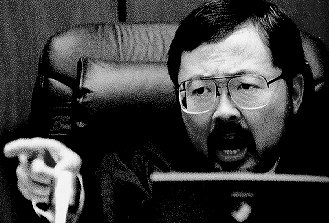
Judge Lance Ito
Over the next 99 days of trial, the prosecution put frontwards 72 witnesses. The start set of witnesses suggested that Simpson had the motive and opportunity to kill. The second set of witnesses suggested that Simpson had in fact used his opportunity to kill his ex-wife and Ronald Goldman.
The first grouping of witnesses included relatives and friends of Nicole, friends of O. J., and a 9-1-1 dispatcher, all produced to demonstrate Simpson's motive and his history of domestic abuse. Nicole's sister, Denise Chocolate-brown, described seeing O. J. at the trip the light fantastic recital of his daughter, Sydney, on the twenty-four hour period of the murder. She testified that Simpson looked "scary," similar a "madman." She told of a dinner attended by her, Nicole, and other friends in which O. J. grabbed Nicole's crotch and said, "This is where babies come from, and this belongs to me." Tearfully, she told of an incident in which an enraged Simpson picked up her sis and threw her confronting a wall. Ron Shipp, a friend of O.J.'south, testified that Simpson told him, "I've had some dreams of killing Nicole." A nine-1-1 dispatcher took the stand so that the prosecution might play for the jury a terrifying ix-1-one call from Nicole describing an ongoing assault by Simpson.
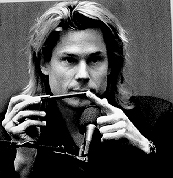
Kato Kaelin
The prosecution side by side produced a set of witnesses--including limousine driver Allan Park, Kato Kaelin, and officers of the LAPD--to establish a timeline of events that left Simpson with ample opportunity to commit murder. Limo commuter Allan Park proved to exist one of the prosecution's nearly constructive witnesses. Park testified that he arrived at the Simpson home on Rockingham at 10:25 to pick O. J. up for his scheduled flying to Chicago. He said he rang the doorbell repeatedly, but received no answer. Soon earlier 11:00, according to Park, a shadowy figure--black, tall, most 200 pounds, and wearing dark clothes-- walked up the driveway and entered the firm. A few minutes after, Simpson emerged, telling Park he had overslept. Park testified that as he entered the limo, he carried a small blackness bag (which the prosecution hoped the jury would conclude contained the murder weapon). Park testified that Simpson would not let him bear upon the bag. The bag has never been seen since. A skycap at the Los Angeles Airport testified that he saw Simpson nigh a rubbish bin.
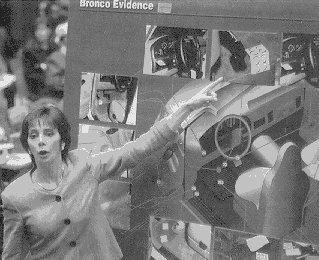
Prosecutor Marcia Clark points to exhibit during trial
Simpson house guest Kato Kaelin, ane of the trials more colorful characters, testified that he and Simpson returned from a run for Big Macs and french fries at 9:36. After that, Kaelin couldn't account for Simpson's whereabouts. He told of hearing thumps on his wall simply earlier xi:00, about the same time that Park witnessed the shadowy figure enter the house. The prosecution too produced telephone records that show Simpson used his automobile cell phone to call his girlfriend, Paula Barbieri, at x:03. The defence did not attempt to explicate why Simpson would make a call on his motorcar cell phone at a fourth dimension he claimed to exist in his backyard practicing his golf stroke.
Finally, the prosecution began to put forrad witnesses directly tying Simpson to the two murders. The bear witness was technical and coexisting, relating mostly of the results of claret, hair, fiber, and footprint assay from the Bundy offense scene and Simpson's Rockingham home. The nearly compelling testimony--if i assumed the accuracy of the testing--concerned two RFLP tests. The first indicated that blood establish at the criminal offense scene could have come from only 1 out of 170 meg sources of blood--and that O. J. Simpson fit the contour. The second came from blood found on two black socks at the foot of O. J.'s sleeping room. According to prosecution testimony, but 1 out of 6.8 billion sources of claret matched the sample. Nicole Brown Simpson might well be the only person on world whose claret matched the blood found on the socks. On cross-examination of the prosecution's Dna experts, the defense had little choice merely to begin to develop the theory that either the blood samples were contaminated or they were planted past corrupt police officers [LINK TO SUMMARY OF Primal PROSECUTION Evidence].
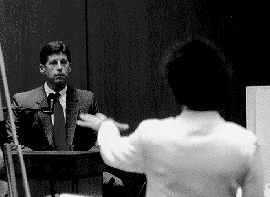
Marcia Clark examines Mark Fuhrman
The LAPD officeholder who found a bloody glove outside Kato Kaelin's bedroom turned out to be a godsend for the defense'southward corrupt-constabulary theory. The officer, Mark Fuhrman, testified for the prosecution on March nine and 10. In his book virtually the trial, Robert Shapiro wrote: "A suddenly charming Marcia Clark treated him like he was a affiche boy for apple tree pie and American values." Three days later on, F. Lee Bailey began a bullying cross-examination of Fuhrman in which he asked the detective, whether, in the past ten years, he had e'er used "the n word." Fuhrman replied that he admittedly never had done so. Information technology was a lie.
A second prosecution disaster followed. Prosecutor Christopher Darden, confident that the bloody gloves belonged to Simpson, decided to make a dramatic courtroom demonstration. He would ask Simpson, in full view of the jury, to endeavour on the gloves worn past Nicole'due south killer. Judge Ito asked a bailiff to escort Simpson to a position near the jury box. Darden instructed Simpson, "Pull them on, pull them on." Simpson seemed to struggle with the gloves, then said, "They don't fit. See? They don't fit." Later on, information technology would plough out that at that place were skilful reasons why they didn't fit--the gloves may take shrunk because of the blood, photos would turn up showing Simpson wearing ill-fitting gloves--but the damage had been done. Later, Cochran would offer the memorable refrain, "If it doesn't fit, you must acquit."
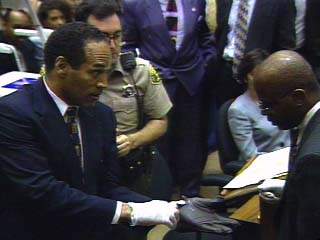
Simpson tries on the bloody gloves
A field trip that included the judge, the jury, lawyers for both sides, the accused, and a bevy of trailing media types illustrates how the defense early on in the trial saw the race issue equally playing to its reward on a jury that included 9 African- Americans. The trip to the Bundy Avenue crime scene and Simpson's Rockingham home was intended to provide the jury with a better basis for understanding testimony concerning locations of bodies, gloves, and socks. The defense saw information technology as an opportunity to put a favorable spin on Simpson's life. Before the jury arrived at Simpson's domicile, down came a picture of Paula Barbieri, O. J.'s girlfriend. In its identify, up went a Norman Rockwell print from Johnnie Cochran's office that depicted a blackness daughter being escorted to school by federal marshals. Pictures of Simpson standing with white golfing buddies were replaced with pictures of his mother and other black people. A Bible was installed clearly on an end table in the living room. The tour seemed to go wonderfully well for the defense force. As the group toured his home, Simpson pointed to a backyard play surface area and said, "That'due south where I skilful my golf swing."
The Dream Team Takes Center Phase
The strategy of Simpson'southward defense team, chosen the "Dream Team" in the media, was to undermine the prosecution'southward testify concerning motive, suggest Simpson was physically incapable of committing the criminal offense, raise doubts about the prosecution's timeline, and finally to advise that the key concrete testify against Simpson was either contaminated or planted, or both.
On July 10, 1995, Simpson'southward daughter Arnelle took the stand as the first defense witness. She would be followed past Simpson's sister and his mother, Eunice Simpson. By the time Simpson's female parent finished her testimony, information technology was credible to some courtroom observers that jury members were showing more empathy for the Simpson family than for the families of the victims.
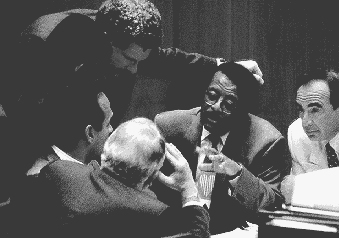
The "Dream Squad" confers
As successful as information technology turned out to be, the defence force endeavor was non without its own miscalculations. After Simpson's dr., Robert Huizenga, testified that O. J.--despite looking like Tarzan--was in about as good of a condition as "Tarzan's grandfather" and suffered from arthritis and other bug, the prosecution produced a video taken shortly before the murders. The video showed Simpson leading demanding physical exercises. Especially embarrassing for the defense was a quip on the tape from Simpson equally he performed an exercise that consisted in part of punching his arms back and forth. Simpson suggested people might endeavour this workout "with the wife."
The virtually talked-virtually aspect of the defense instance undoubtedly concerned Mark Fuhrman, the LAPD officer who had found the encarmine glove and who, as a prosecution witness, denied using the give-and-take "nigger." It turned out that Fuhrman had used "the n discussion"--many times--and it was on record. Laura Hart McKinny, an aspiring screenwriter from North Carolina, had hired Fuhrman to consult with her on law problems for a script she was writing. McKinny taped her interviews with Fuhrman, who not only used the offensive racial slur, just disclosed that he had sometimes planted prove to help secure convictions. Needless to say, the defense wanted McKinny on the stand, and they wanted the jury to hear selected portions of her tapes. The prosecution strenuously objected, arguing that McKinny'south testimony was irrelevant absent-minded some plausible bear witness suggesting that evidence was planted in the Simpson case. The prejudicial value of the testimony, the prosecution insisted, would exceed its probative value. Judge Ito, somewhat reluctantly, allowed the defense evidence. Ito's decision opened the door for the defence to offer its rather fantastic theory that Fuhrman took a glove from the Bundy law-breaking scene, rubbed it in Nicole's blood, and then took it to Rockingham to drop outside Kaelin's bedroom so as to frame Simpson.
Information technology may not, however, take been Fuhrman, but rather a soft-spoken Chinese-American forensic adept named Henry Lee that won Simpson his acquittal. Lee had solid credentials, smiled at the jury, and provided what seemed to be a plausible justification for questioning the prosecution's key physical show. Lee raised doubts with blood splatter demonstrations, his suggestion that shoe print evidence suggested more than than one assailant, and his elementary decision about the prosecution'south DNA tests: "Something's wrong." He might have, as Christopher Darden speculated after the trial, been the person who gave the jury "permission" to do what they wanted to do anyway: acquit Simpson. Jury forewoman, Amanda Cooley, called Lee "a very impressive gentleman." Another juror agreed, describing Lee as "the most credible witness," a person who "had a lot of impact on a lot of people."
The Jury Acquits
By the time closing arguments began in the Simpson case, the trial had already broken the tape set past the Charles Manson instance as the longest jury trial in California history. The jury had been sequestered for the better office of a twelvemonth and was showing signs of strain and exhaustion. Gauge Ito was nether attack for the allowing the trial to drag on and his seeming inability to keep lawyers under control.
Marcia Clark'due south summation for the prosecution sought, among other things, to practice impairment command on the Fuhrman issue. Clark denounced Fuhrman as a racist, the "worst type" of cop, and as someone we didn't want "on this planet." But, she told the jury, that doesn't mean there was a frame-upward. She took the jury again through the prosecution'south "mountain of evidence" every bit puzzle pieces on a video screen accumulated to reveal the face of O. J. Simpson. Christopher Darden followed Clark, telling the jury that Simpson could be "a great football thespian" and "a murderer" also.
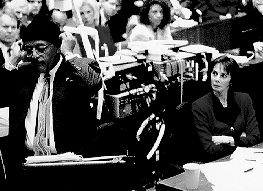
Johnnie Cochran models a stocking cap during his summation
Johnnie Cochran's summation for the defense force added controversy to an already very controversial trial. His co-counsel, Robert Shapiro, was later to condemn his closing for "not only playing the race card, merely playing information technology from the lesser of the deck." Cochran compared the prosecution case to Hitler's entrada against the Jews:
There was another human not besides long ago in this world who had those aforementioned views, who wanted to burn people, who had racist views, and ultimately had power over people in his country. People didn't intendance. People said he's crazy. He's just a half-baked painter. And they didn't exercise anything virtually it. This human, this scourge, became one of the worst people in the world, Adolf Hitler, because people didn't intendance, didn't stop him. He had the power over his racism and his anti-religionism. Nobody wanted to stop him....And and then Fuhrman. Fuhrman wants to have all black people now and burn them or bomb them. That's genocidal racism. Is that ethnic purity? We're paying this human being's salary to espouse these views...
The jury spent only three hours deliberating the example that had produced 150 witnesses over 133 days and had toll $xv million to try. As America watched at 10 a.m. PST on October three, 1995, Ito's clerk, Deidre Robertson, announced the jury's verdict: "We the jury in the above entitled action observe the defendant, Orenthal James Simpson, non guilty of the criminal offence of murder." Simpson sighed in relief, Cochran pumped his fist and slapped Simpson on the back. The Dream Team gathered in a victory huddle. From the audience came the searing moans of Kim Goldman, Ron's sis, and the cry of his female parent Patti Goldman, "Oh my God! Oh my God!"
Simpson appear after the verdict that he would devote the rest of his life to tracking downwards the real killers of his ex-wife, but he would soon exist preoccupied with a civil trial. The trial, held in Santa Monica, would have only three months and would produce a very different result. Simpson was forced to bear witness, clumsily trying to explicate the unexplainable. Photos showing Simpson wearing the size 12 Bruno Magli shoes that he claimed not to ain turned up outset in i newspaper, then in others. The judge in the civil trial, Hiroshi Fujisaki, proved he was no Lance Ito, and prevented the Simpson defense force from introducing fanciful theories of a top-to-bottom conspiracy. After seventeen hours of deliberation, the jury concluded--using the preponderance of the evidence test applicative in civil cases--that O. J. Simpson had wrongfully caused the decease of Ronald Goldman and Nicole Brown Simpson. The jury ordered Simpson to pay compensatory amercement of $viii.five million and punitive damages of $25 million. Nether California police, yet, Simpson can go along to survive on the $25,000-a-month income from a judgment-proof pension fund. In 2000, Simpson moved to Miami, Florida. Florida is 1 of the few states where assets such as homes and pensions cannot be seized to pay civil liabilities from other states.
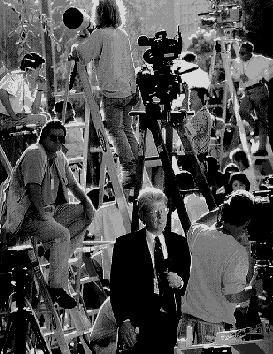
Media gathers outside courthouse
Simpson's legal troubles still were not over, nevertheless. In 2007, Simpson coordinated a gunpoint assault and robbery of 2 sports memorabilia dealers in a Las Vegas hotel room. Simpson claimed that he was simply trying to recover memorabilia that was rightfully his, but the jury thought otherwise. Simpson received a 9 to 33-twelvemonth sentence for robbery, assault with a deadly weapon, and kidnapping. He served his term at the Lovelock Correctional Eye near Reno, Nevada. He was granted parole in 2017, and all restrictions on motility and beliefs were lifted past the Nevada Parole Board on December ane, 2021. Prison was not like shooting fish in a barrel for O.J., who in 2015 was slammed against a wall and threatened with death past a white supremacist inmate after Simpson cutting alee of him in a line for medication. Three months subsequently, a former cellmate of Simpson also threatened to impale him when O.J. refused to pay him the amount of protection coin he thought he was due.
In 2006, a publisher announced a book written by O. J. Simpson called "If I Did Information technology." The publisher told the Associated Printing, "This is an historic case, and I consider this his confession." In the book, Simpson describes angrily confronting Nicole and Ronald Goldman at Nicole's condo on the nighttime of the murder, knife in his hand. Then he writes, "Something went horribly wrong, and I know what happened, merely I can't tell you exactly how." He continues, "The whole front of me was covered in blood, but it didn't compute." Interestingly, in Simpson's account of the murder, he describes himself as having been accompanied to the condo by a friend named "Charlie," who was shocked by the bloody turn of events. On the manner back to Simpson's domicile, Charlie said, "Jesus Christ, O.J., Jesus Christ," and buried his confront in his hands.
The announcement of the volume met with a avalanche of criticism. Ron Goldman'south sister, Kim Goldman, on CNN'due south Larry King Alive, expressed the outrage of victims: "He's telling us 1 more fourth dimension, 'I'm gonna continue to become away with killing your family unit members and I'm not gonna honor the judgment and await at me, ha, ha, ha."' The criticism caused HarperCollins to recall the book. A court seized the book as an asset to pay off Simpson'due south civil damages and the book was retitled: "If I Did It: Confessions of the Killer."
The Simpson trial was in one sense simply a "trash novel come up to life." But, in other sense, it was a dandy trial. It revealed in a mode that got everyone'south attention the polarization of racial attitudes on problems such as police enforcement. Information technology showed that African-Americans are, on the whole, much more probable to suspect police of racism and misconduct based on their experiences than are whites. It may be for that insight, more than than anything, that the Simpson trial volition be remembered.
Simply the trial had other profound effects. It created a greater sensation of domestic violence bug. It provided lessons in how not to run a criminal trial, lessons practical by judges in subsequent celebrity trials.
Finally, the Simpson trial reversed what had been a powerful trend towards allowing the use of cameras in criminal courtrooms. And those cameras in the Simpson courtroom fabricated possible a new type of "immersion" journalism. Journalism that follows a sensational story almost obsessively twenty-four hour period after day—a type of journalism that still flourishes today.
The Simpson trial demonstrated the polarization of racial attitudes on problems such as police force enforcement that all the same exists in our country [POLLING DATA ON SIMPSON VERDICT]. It may be for that, more than anything, that the trial volition be remembered. Simply it had other effects. It created a greater sensation of domestic violence issues, provided lessons in how non to run a criminal trial, slowed the trend toward the apply of cameras in courtrooms, and created a new type of "immersion" journalism that nonetheless flourishes today.
Source: https://famous-trials.com/simpson/1862-home

Post a Comment for "When You Commit Murder Are You Liable to Do It Again"